ERC Starting Grant awarded to Junsoo Han, member of the DIADEM PEPR
Publié le
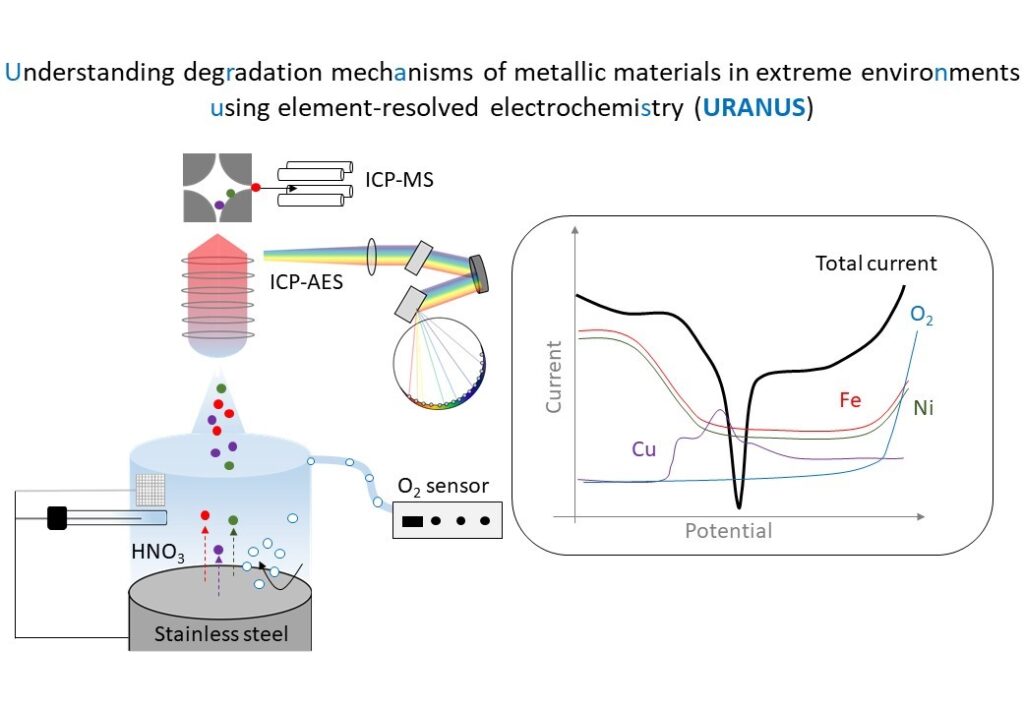
The PEPR DIADEM congratulates Junsoo Han, senior lecturer at Sorbonne University and researcher at the Electrochemical Interfaces and Systems Laboratory (LISE – CNRS/Sorbonne University), on being awarded an ERC Starting Grant 2025 for his project URANUS (Understanding degradation mechanisms of metallic materials in extreme environments using element-resolved electrochemistry).
From CROCUS to URANUS: exploring corrosion reactions at the elemental level
Coordinator of the CROCUS project (Microlaboratory for the Design of Anti-Corrosion Solutions), a project resulting from the PEPR DIADEM 2023 call for proposals, Junsoo Han is developing innovative approaches to high-throughput electrochemical analysis at the elemental level for the design of new corrosion-resistant alloys and coatings. The CROCUS project aims to design (IRCP Chimie ParisTech), produce anti-corrosion materials (CEA/ISAS/Corrosion and Material Behavior Research Department – S2CM) and test them electrochemically at the elementary level (LISE Sorbonne University). The links with the A-DREAM and DIADEM-2D platforms are naturally very important.
With URANUS, he has taken a new step forward: the development of a novel element-resolved electrochemistry system capable of operating in extreme environments such as molten salts (used in certain nuclear reactors) or nitric acids (involved in nuclear waste recycling), in collaboration with CEA/ISAS/S2CM and IRCP.
The goal: to reveal the mechanisms of degradation of metallic materials under these severe conditions, obtaining physicochemical information that cannot be extracted using conventional electrochemical methods.

My proposal aims to reveal information hidden in conventional electrochemistry,“ explains Junsoo Han. ”This approach will provide a better understanding of material sustainability and accelerate the design of new generations of eco-friendly metallic materials.”
A unique experimental platform
The URANUS project will be based on the development of a new system combining electrochemistry with inductively coupled plasma mass spectrometry (ICP-MS) and other analytical techniques, such as in situ gas measurement. This platform will enable in situ, element-resolved analysis during electrochemical reactions, paving the way for applications in:
- the energy sector (batteries, nuclear reactors, electrocatalysts, conversion processes),
- the recycling of alloys from nuclear waste,
- advanced characterization of materials to better understand the fundamental kinetics of elemental dissolution.
Strong synergies with the PEPR DIADEM program
The URANUS project complements the work undertaken within the DIADEM PEPR, particularly through the associated AESEC (Atomic Emission SpectroElectroChemistry) techniques developed in CROCUS, for example: a local flow electrochemical cell.
This convergence between the CROCUS and URANUS projects and other initiatives within the program (such as DIAMOND for digital design and AI applied to materials) illustrates the interdisciplinary dynamic that the PEPR DIADEM program seeks to encourage.
The fact that I was the coordinator of a PEPR DIADEM project was particularly appreciated by the ERC jury,” Junsoo Han points out. “It demonstrates my ability to lead a research project within a large-scale national collaborative network.”
To stay informed about our news and upcoming events, sign up for our newsletter!
Plus d'actualités