Session: “Introduction to Deep Learning for Image Classification and Object Detection”
Publié le
In May, the DIADEM Academy held its latest training session, “Introduction to Deep Learning for Image Classification and Object Detection,” in Bordeaux.
The goal of this session was to guide learners from diverse backgrounds in discovering the fundamentals of deep learning, enabling them to understand how to implement the associated algorithms and code and to consider how to adapt them to the specific research challenges faced by each learner.
To kick off the training, participants were welcomed for an afternoon of tours and explorations at two PEPR DIADEM partner institutions: CEA Tech and the ICMCB (Bordeaux Institute of Condensed Matter Chemistry). This immersive experience allowed them to learn about several research projects as well as the associated experimental platforms.
Tour and presentation of targeted projects
At CEA Tech, Gunay Yildirim and Frédéric LECRAS presented the activities carried out as part of the HIWAY-2-MAT targeted project, focusing on combinatorial synthesis via physical vapor deposition (PVD). To provide a broader view of the activities taking place at the site, Gunay also invited several colleagues to present other ongoing projects, particularly in the fields of cobotics and THz applications. This immersive experience was particularly appreciated by the participants, offering a concrete glimpse into research projects that are as varied as they are exciting.
The afternoon then continued at the ICMCB, where Aline Rougier and Lionel Teule-Gay presented other aspects of the HIWAY-2-MAT project using various instruments dedicated to the characterization of thin films.
Next, Cyril Aymonier gave us a tour of a laboratory used as part of the 2FAST project, which explores the use of miniaturized and continuous synthesis processes to optimize and accelerate the development of new materials.
Following the tours, Glenn Clothier from the Laboratory of Organic Polymer Chemistry (LCPO) presented the AMETHYST project, which aims to accelerate the development of higher-performance and more sustainable polymer materials through the combination of artificial intelligence and high-throughput experimental methods.
The day concluded with a presentation by Fabrice Rossignol on the RUBIS project, which aims to optimize the design and manufacturing of thermostructural ceramics and composites by leveraging data science and artificial intelligence in the field of advanced materials and manufacturing processes.
Focus on training
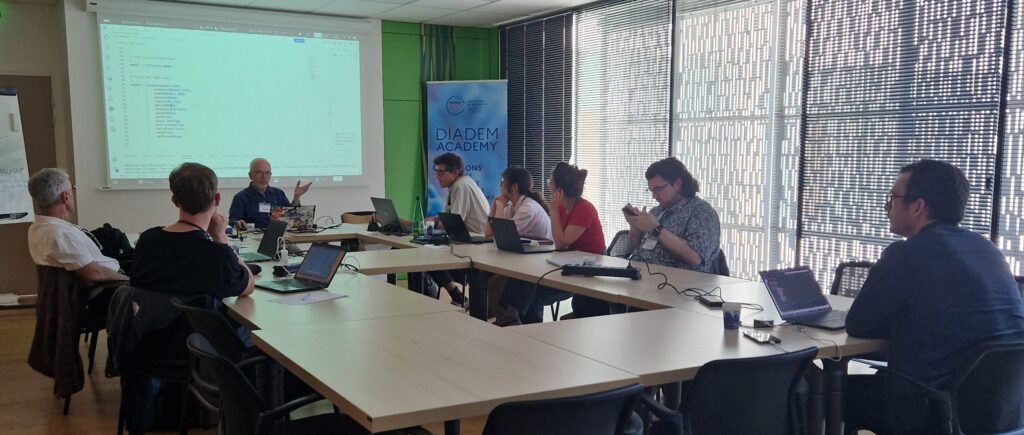
Once again, the group was very diverse. Doctoral students, postdocs, technicians, engineers, and researchers attended this training session, with specializations that were sometimes very different from one another. This perfectly illustrates the growing interest in artificial intelligence and the ability of deep learning methods to be applied to a wide variety of scientific and technical problems.
The program offered an introduction to two major topics in computer vision: image classification and object detection. This approach allowed participants to gain an initial understanding of the fundamental concepts while putting them into practice through guided exercises.
This feedback also provides valuable insights for improving future editions. We are therefore considering ways to refine the structure of this training program to facilitate better understanding of the concepts and allow for a deeper exploration of certain topics. This is the key benefit of our customized training programs: the ability to adapt them based on participant feedback and needs.
A trainer who makes deep learning accessible
Beyond the quality of the content, participants particularly praised Jean-Luc Charles’s teaching skills. A former Senior Lecturer (HDR) at ENSAM, he was able to make concepts, sometimes perceived as complex, accessible through detailed explanations, a clear progression, and numerous concrete examples.
His infectious enthusiasm and passion for artificial intelligence methods were widely appreciated. Beyond the technical aspects, participants left with a better understanding of the challenges and developments in deep learning, thereby enriching their general knowledge. This successful knowledge transfer helped make the session a particularly enriching experience.
Thank you to all the participants and the local teams
First of all, we would like to thank Cyril Aymonier, director of the ICMCB, for his presentation on 2FAST and for making it possible to host this training session at the laboratory.
We would also like to thank the speakers who took the time to present their projects to us:
- Gunay Yildirim, Frédéric LECRAS, Aline Rougier, and Lionel Teule-Gay for HIWAY-2-MAT
- Glenn Clothier for AMETHYST
- Fabrice Rossignol for RUBIS
We would also like to thank Lucie Bard and Mario Maglione of the PEPR DIADEM, based at the ICMCB, for their logistical support and their willingness to assist.
Finally, we would like to extend a special thank you to Jean-Luc Charles, our instructor, for his warm and engaging manner, his teaching skills, and his expertise, all of which contributed greatly to the success of this training program.
To stay up to date on our news and upcoming events, sign up for our newsletter!
Plus d'actualités