
AI-MAHC : Artificial Intelligence-Driven MOF Materials Discovery for Autonomous Humidity Control.
Coordinator: Guillaume MAURIN
Université de Montpellier
Keywords: Metal organic frameworks (MOFs), Water adsorption/desorption, autonomous humidity control, construction and analysis of structure database, high-throughput screening by molecular simulations (Monte Carlo and molecular dynamics), machine learning, artificial Intelligence-aided design of novel materials, high-throughput synthesis and characterization, water adsorption (thermodynamics and kinetics), humidity controller prototype (building physics)
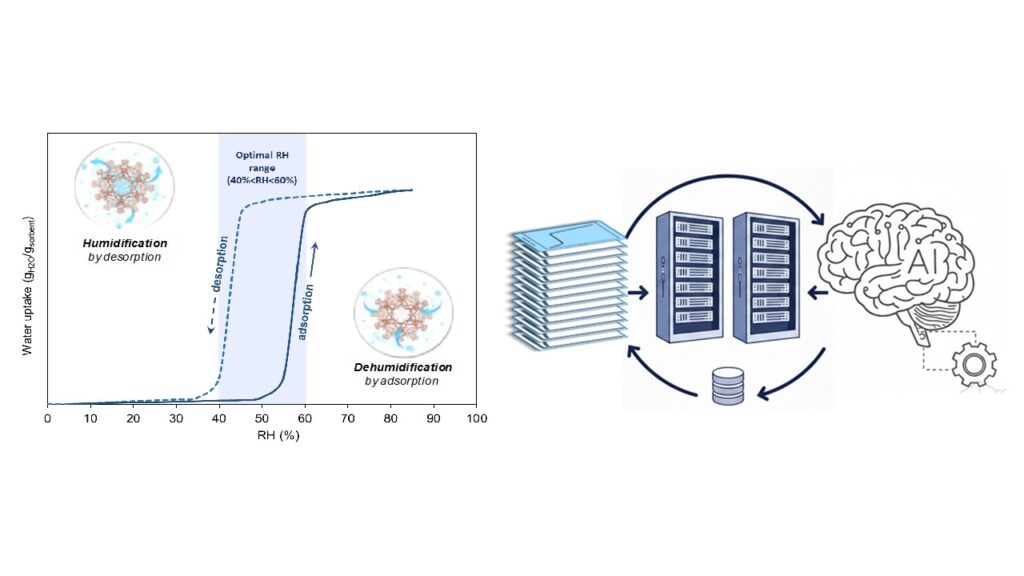
Driven by growing concerns about indoor air quality, rising humidity levels, and the increased frequency of extreme weather events. Current humidity control systems such as dehumidifiers, humidifiers, and heating-based solutions, air conditioning, and ventilation (HVAC), have significant drawbacks, including high energy consumption, maintenance requirements, the use of refrigerants with high global warming potential, and inaccuracy in regulating optimal humidity levels. These limitations highlight the need to find more effective humidity control solutions to meet growing demand in a sustainable manner. Autonomous humidity control (AHC) systems, incorporating advanced porous materials, are set to revolutionize HVAC technologies, particularly in the context of the Green Deal objectives (carbon-neutral economy by 2050).
AHC systems aim to autonomously modulate indoor air humidity levels using a porous material capable of adsorbing water as soon as the relative humidity (RH) reaches 60% and rapidly desorbing water when RH reaches 40%, without external intervention, to preserve the health and comfort of occupants.
Today, none of the conventional porous adsorbents, such as silica gels and zeolites, are optimal for the intended application because their water adsorption occurs outside the desired RH range and they have insufficient water adsorption capacities and slow adsorption kinetics. It is therefore essential to design new porous adsorbents with ideal water adsorption characteristics. While some porous hybrid materials such as MOFs show promising performance, we are still far from fully exploiting the immense potential of this family of materials, as their selection is still largely based on serendipity.
Our goal is to develop an unprecedented strategy based on high-throughput digital screening, machine learning (ML) techniques, artificial intelligence (AI) tools, high-throughput robotic synthesis/characterization, and advanced adsorption techniques to discover new robust, sustainable, and non-toxic MOFs with exceptional moisture control performance. The best MOFs will be produced on a larger scale, shaped, and integrated into a prototype to test their performance under real-world conditions and evaluate their potential energy savings compared to conventional humidity control technologies. This will establish an initial proof of concept that will pave the way for further development and eventual industrialization.
This project will be carried out in close collaboration with the DIAMOND platform (database/codes/force field learning) and the MOFs Learning platform (high-throughput synthesis robot and data standardization). This project brings together three French academic groups and an international collaborator with complementary skills to promote strong synergy between numerical simulations (high-throughput screening, force field derivation, ML/AI model development) applied to porous solids (G. Maurin, ICGM, Montpellier University), automated synthesis/characterization/shaping and scaling of MOFs (C. Serre, IMAP, ENS, ESPCI, CNRS, PSL), and adsorption testing (I. Bezverkhyy, ICB, University of Burgundy, CNRS) for the engineering of dehumidification devices and testing under real-world conditions (M. Qin, Technical University of Denmark-TUD).