
COAST : Catalysts for a sustainable future.
Coordinator: Emilie GAUDRY
Université de Lorraine
Keywords: Intermetallic compounds, CO2 reduction to methanol, catalysis, high-throughput screening, surface science
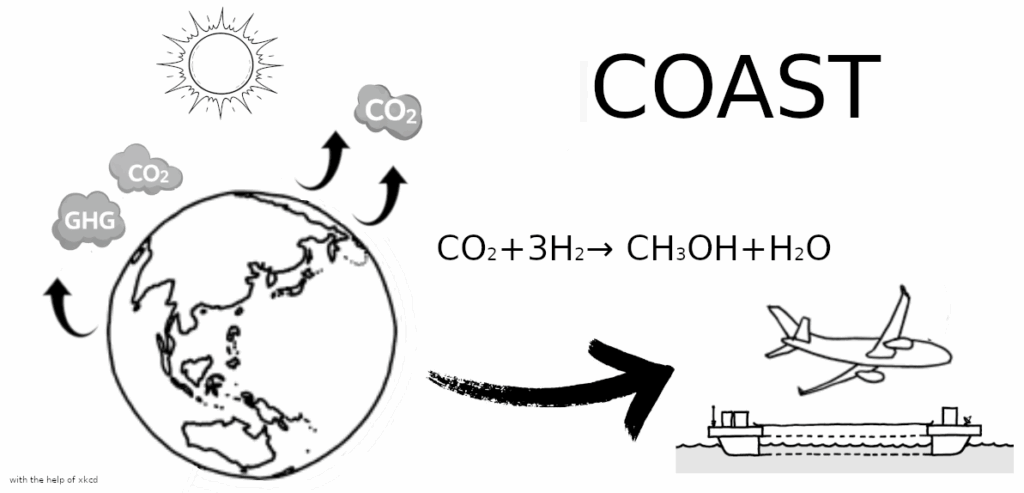
Greenhouse gas emissions are a key driver of climate change, with the transportation sector being one of the largest contributors. Transitioning this sector toward sustainability is complicated by rising transport demand. While optimizing vehicle materials to reduce weight and improve fuel efficiency is important, the shift towards alternative fuels plays an even more central role in mitigating emissions. Methanol stands out as a promising alternative to conventional fuels, offering a decarbonization solution for industries reliant on liquid fuels. This can be achieved by converting CO₂ into methanol using green hydrogen. Beyond being an energy carrier, methanol serves as a critical building block in chemical processes. Moreover, methanol fuel cells can directly convert fuel into electricity, offering a more compact and long-lasting energy source than traditional batteries
The thermal catalytic CO₂ hydrogenation process is currently the most promising method for large-scale methanol production. Its effectiveness largely depends on the catalysts used. In recent years, notable progress has been made with Cu/ZnO/Al₂O₃ catalysts for CO₂ hydrogenation. However, reaction conditions lead to high energy consumption, and limit the CO₂ content in the feed gas (~10%) to maintain high selectivity. As such, there is a significant need for new catalyst materials that can operate efficiently at lower pressures.
The PEPR project envisions the use of intermetallic catalysts for a more sustainable future, potentially replacing traditional noble metal catalysts. This approach aligns with current trends focused on minimizing the use of critical elements. We will explore structure-property relationships in the form of TM-sp (transition metal – poor metal) intermetallics or supported TM-sp phases, with oxide support. The project combines numerical, experimental and methodological approaches. Machine learning methods will be developed, to carry out predictions precise enough to be usable with a minimum of data. In terms of numerical simulations, we will use global optimization methods, approaches based on density functional theory, as well as approaches based on machine learning interaction potentials. Two datasets will be elaborated : one gathering experimental data and one containing results from ab initio calculations.
Project partners : IJL (Institut Jean Lamour), INSP (Institut des Nanosciences de Paris), IRCELYON (Institut de Recherche sur la Catalyse et l’Environnement de Lyon), LORIA (Laboratoire Lorrain de Recherche en Informatique et ses Applications, SOLEIL (Source Optimisée de Lumière d’Energie Intermédiaire du LURE).