
ExplorMat : Accelerated Exploration of a Chemical System for the Discovery of New Materials for Photovoltaics and Solid-state Lighting.
Coordinator: Romain GAUTIER
CNRS – Institut des Matériaux de Nantes Jean Rouxel
Keywords: Autonomous robot, automated exploration, hybrid metal halides, descriptors, exploration model, white photoluminescence, solid-state lighting, photovoltaics, ab initio calculations
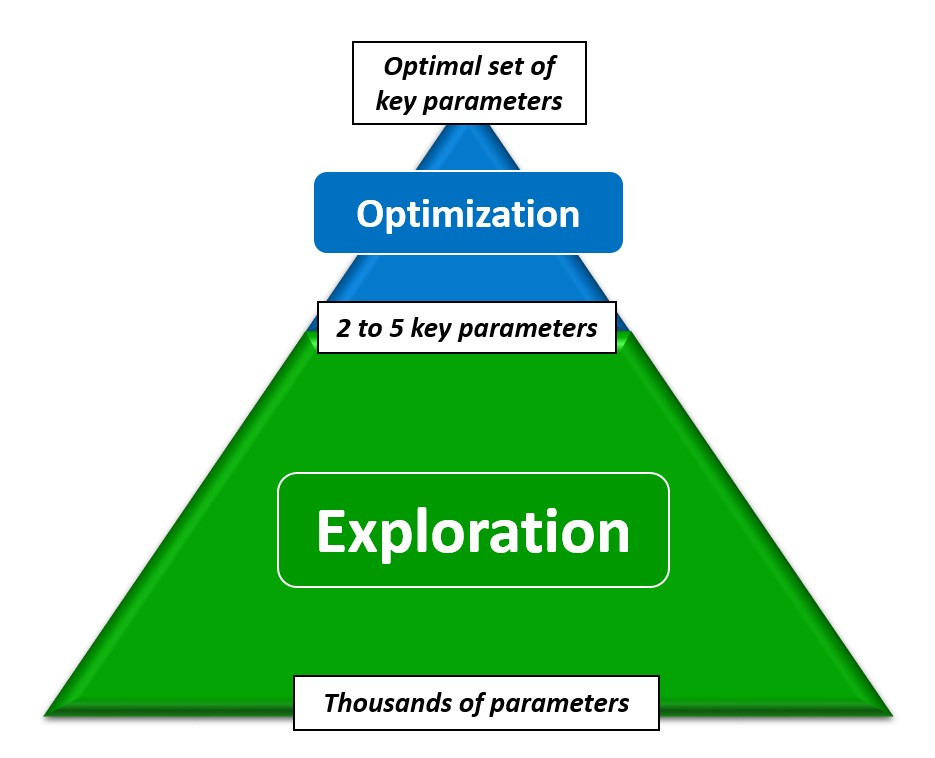
Traditional methods for discovering new materials are often lengthy and repetitive. Recent advances in the application of ready-to-use optimization algorithms within closed synthesis characterization-prediction cycles have accelerated the discovery process. However, the chemical systems studied are predefined by scientists and must be limited to a low dimension. Thus, machine learning methods, commonly used today in closed loops, are suitable for optimization but not for discovering new exceptional materials, because these optimization algorithms do not “think outside the box” created by scientists and, for this reason, cannot make revolutionary discoveries.
As part of the ExplorMat project, a new methodology that generates new scientific knowledge will be developed to exhaustively explore the chemical space and discover new exceptional materials for photovoltaic technologies and LEDs.
The main strategy consists of designing an exploration algorithm that will focus on unexplored regions of chemical space. To demonstrate the potential of this exploration algorithm, a closed loop between (1) synthesis, (2) characterization, and (3) decision-making will be developed. High-throughput decision-making integrating this new exploration algorithm, based on multi-agent systems and data mining, will generate new hypotheses, decide which chemical systems to explore, and efficiently propose a set of new syntheses, which will be executed at high throughput on a robotic platform installed at IMN. The results of the new syntheses will improve the performance of the exploration algorithm. Automated iterations between decision-making and experimentation will operate independently of any human intervention.
The synergy between the collection of experimental data via a robotic platform and its use by a series of new techniques based on chemical space exploration will be initiated by an interdisciplinary team of chemists, spectroscopists, computational materials specialists, machine learning experts, and mathematicians. The optical properties of the hybrid metal halide family will be studied. The objective will be to develop and demonstrate the effectiveness of this new methodology by proving its ability to outperform traditional approaches and those based on optimization algorithms in the discovery of new white photoluminescent materials based on hybrid metal halides for LED lighting and solar absorbers for photovoltaics.