
GREENTEA : high-throughput GeneRation via machinE lEarning of New ThErmoelectric sulfide alloys composed of Abundant elements.
Coordinator: Mickaël BEAUDHUIN
MCF HC
Keywords: Thermoelectricity, artificial intelligence, machine learning, learning reinforcement, high throughput synthesis, high-throughput characterization, soft-chemistry, green deal, sulfide, eco-design
This project focuses on converting thermal energy into electrical energy or vice versa by applying an eco-design approach.
Indeed, i) the search for new sources of green energy is one of the most fundamental challenges for sustaining economic growth and reducing greenhouse gas emissions. ii) the search for new cooling solutions can improve the performance and sustainability of electronic or industrial systems, while offering alternatives to chemical refrigerants that are harmful to the ozone layer and the climate. The use of more efficient or environmentally friendly technologies can thus reduce energy consumption. iii) Thermoelectric generators and cooling devices have the advantage of being small, reliable, quiet, with no moving parts, capable of regulating temperature by modulating heat flow, with no scale effect (from micro to macro generation/cooling), and a long service life. They can operate in any working position and are therefore very suitable for embedded systems. To continue developing this type of technology, it is essential to reduce the cost of the devices and to search for high-performance materials composed of more environmentally friendly elements.
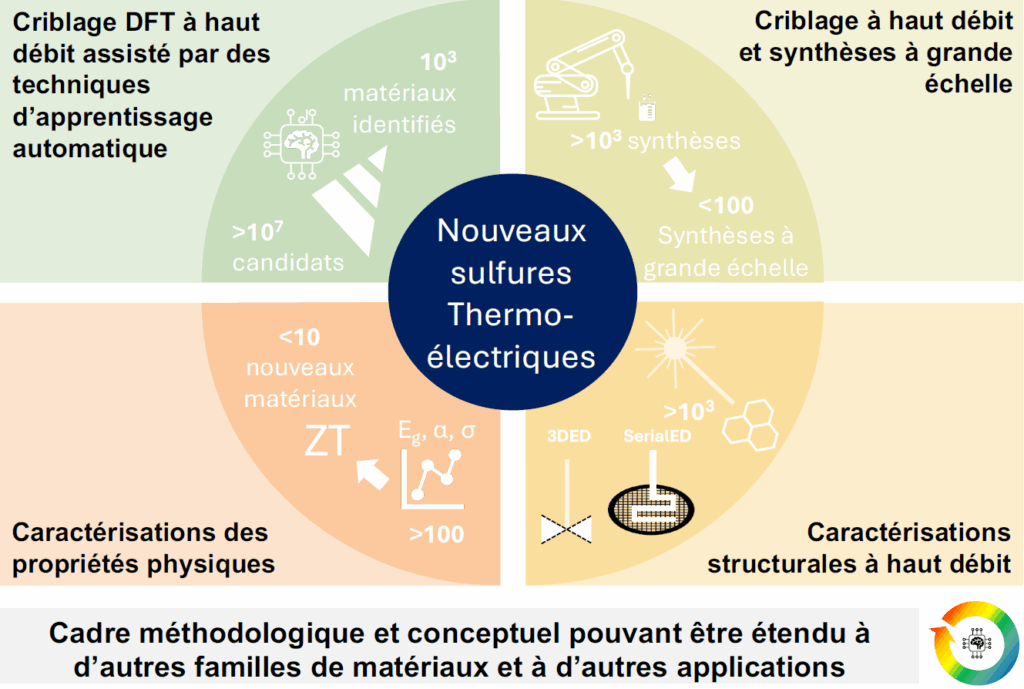
To contribute to this effort, the GREENTEA project is part of an eco-design approach. It is based on a multidisciplinary approach that aims to identify new stable (or slightly metastable) semiconductor compounds within multi-component systems, while integrating eco-design principles to minimize environmental impact from the design phase onwards. To achieve this, it combines high-throughput DFT screening (DFT calculations combined with machine learning techniques) of several million configurations with high-throughput synthesis to accelerate the experimental screening stages. The targeted materials will be synthesized by solution and/or solid-state processes, using the PEPR DIADEM synthesis and characterization platforms, while optimizing the processes to reduce the ecological footprint. The use of AI at each stage of the project will enable the most promising phases for the targeted applications to be identified and selected. This project also aims to validate a methodological and conceptual approach that can be applied to other families of materials and/or other applications in order to accelerate their discovery.