
MASKY : Advanced MAterials for SKYrmion based Spintronics.
Coordinator: Michel HEHN
Université de Lorraine
Keywords: Materials, artificial intelligence, spintronics, skyrmions,
surface acoustic waves, magneto elasticity, DFT, neural network
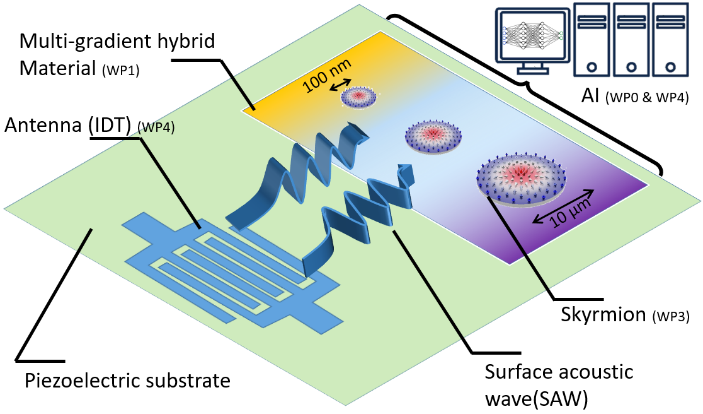
Spintronic components whose operation is based on the use of skyrmions (magnetic chiral
textures of particle-like nature) present promising characteristics for memory logic technologies
beyond CMOS, which would enable more frugal and agile electronics. One of the challenges lies in identifying multilayers of ultra-thin films with the optimal magnetic properties required for the targeted applications that allow to create and stabilize skyrmions with specific properties in terms of size, stability…
We intend to use an approach based on the use of predictive artificial intelligence and data mining to considerably speed up the discovery of candidate hybrid (multilayer) materials. The high volume of data required by AI will be satisfied both by i) the fabrication of multidirectional gradient samples (e.g. thickness and composition varying in three directions of the sample plane) and by ii) their high-throughput characterization. Finally, the prototyping of components will make it possible to verify the predictive capacity of the AI while establishing an additional feedback loop for the AI. We will be focusing in particular on the magnetostrictive properties of the stacks deposited on piezoelectric substrates, in order to find skyrmions that are very sensitive to surface acoustic waves. Research in this area at the interface between skyrmionics and straintronics, a very recent field of spintronics, will thus benefit from the advances made possible by AI. Through the MASKY project, we will demonstrate the transformative nature of the proposed approach, which is currently largely underused in the field of spintronics. In addition to the accelerated discovery of hybrid materials useful in the context of Skyrmion-based components, the method used in MASKY could be transposed to other areas of spintronics and even more broadly to other emerging technologies.
The project is divided into 5 work packages (WP):
WP0 Defining metrics for AI
WP1 Growth of multiple gradient film stacks
WP2 High-speed characterization
WP3 Implementation of predictive AI
WP4 Device prototyping and testing
To carry out this ambitious project, the MASKY consortium will draw on the complementary nature of the expertise brought together by the project partners, as well as on the platforms set up by DIADEM, namely the Daum Tube and the databases designed for storage, management and use by the AI.