
NanoPhiA : Understanding nanoparticle formation in physical synthesis: Using AI to couple characterization, in-situ measurement and simulations.
Coordinator: Julien LAM
CNRS
Keywords: Nanoparticle synthesis, nucleation and crystallization,
in-situ and in-operando instrumentation, digital twins molecular dynamics assisted by machine-learning, big data analysis
The crystallographic structure of nanoparticles directly determines their physico-chemical properties, and a fortiori their application potential. A major challenge in advancing nanotechnologies through the use of nanoparticles therefore lies in our ability to control their size,
crystalline phase, morphology and chemical composition. An empirical approach is currently favored, involving objectification of the relationship between synthesis parameters and morphological and structural characteristics. But the parameter space is sometimes too large for a purely empirical approach to suffice. To go beyond this, it becomes crucial to gain a better understanding of the mechanisms involved during nanoparticle synthesis, and in particular during crystal nucleation.
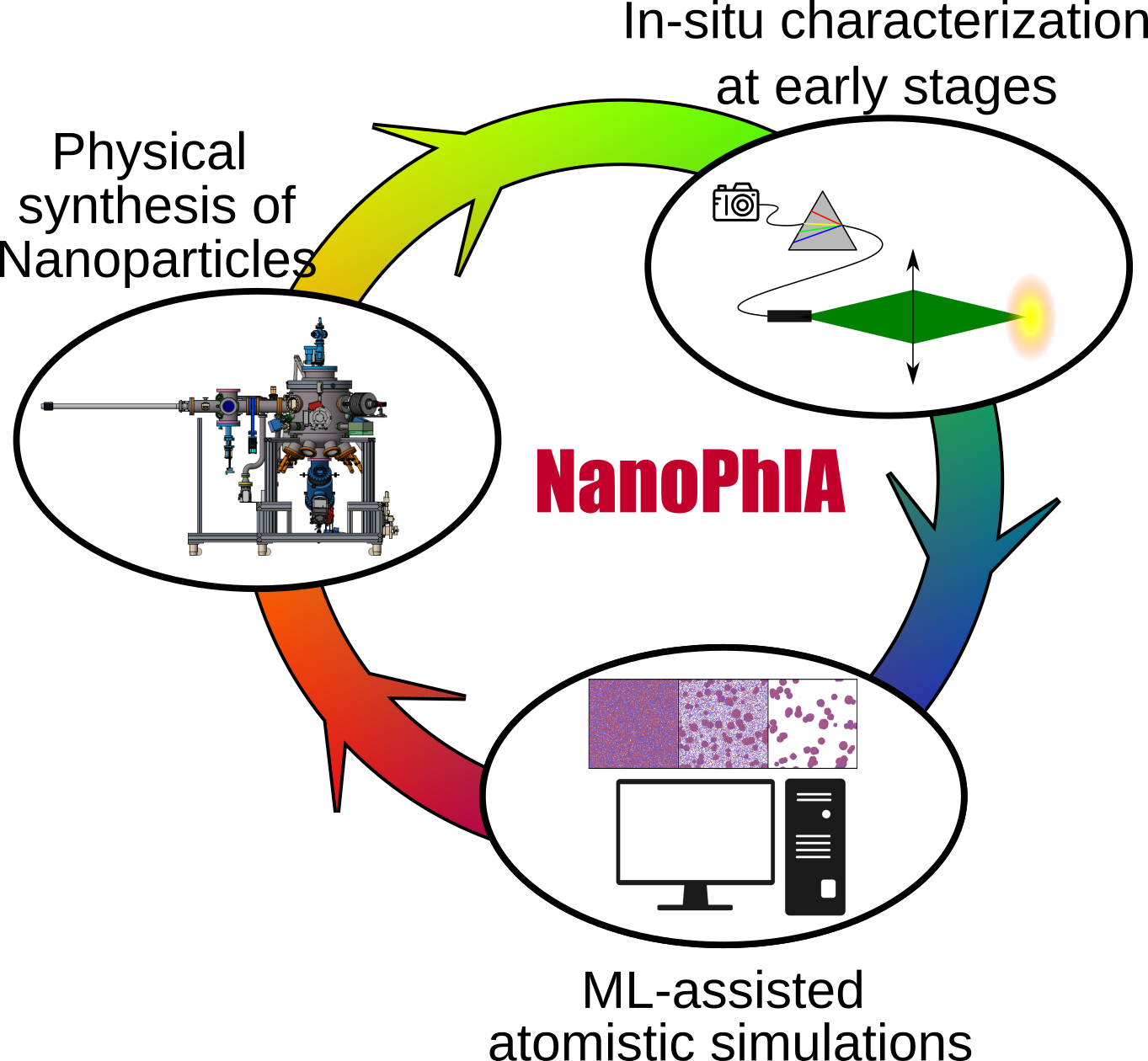
In our project, we are focusing on physical synthesis methods. Our consortium involves three research teams, each with a different physical synthesis method: chemical vapor synthesis (INSP-Paris), magnetron sputtering inert-gas condensation (CEMES-Toulouse) and Laser ablation in liquid (ILM-Lyon). What all these methods have in common is the passage through a plasma phase in which collisions between chemical species enable nanoparticles to nucleate under highly non-equilibrium conditions. By working on the same material, the study will enable us to benchmark synthesis conditions. In practice, we have chosen to work on oxides of gradual complexity ie. ZnO, CuxOy and finally ZnxCuyOz. These materials are of interest from the point of view of catalytic and biomedical applications, but are also rich in structural complexity (polymorphism with possible size dependence). In addition to bringing these three synthesis methods together in a novel way, our project aims to develop a mobile spectroscopy experiment capable of being deployed on the various synthesis experiments. In particular, it will measure the temporal evolution of plasma thermodynamic properties at short times as a function of experimental conditions. Comparison of the methods will enable a mapping of thermodynamic characteristics including a temporal component. Building on these results, we will construct an AI-based model to establish a feedback loop between the experimental parameters imposed in synthesis and the thermodynamic properties. In the third part of our project, we will use machine-learning force-field-assisted molecular dynamics to obtain a numerical twin of the synthesis experiments modeled on the measured thermodynamic properties. Thanks to these numerical simulations, we will be able to 1) observe the dynamics of nanoparticle formation at the atomic scale to better understand the mechanisms, 2) predict the synthesis results to considerably reduce the number of time- and resource-intensive synthesis and characterization experiments, and 3) determine the thermodynamic conditions for obtaining novel nanostructures.
By bringing together synthesis, AI-assisted in-situ observation and machine-learning force-field molecular dynamics, we aim to achieve a comprehensive understanding of the mechanisms involved in the physical formation of nanoparticles. And, above all, we will establish a methodology for predicting the relevant synthesis experiment as well as the appropriate experimental conditions for targeting a specific nanoparticle shape in terms of chemical composition and, above all, structure. Given its fundamental nature, the methodology employed will be perfectly applicable to other oxides, but also to other types of nanoparticles such as carbonaceous materials or nano-alloys.